Aunque el titulo y el manejo de la nota es indecente por parte de El Colombiano (http://www.elcolombiano.com/BancoConocimiento/T/tatequieto_a_becas_de_doctorados_individuales/tatequieto_a_becas_de_doctorados_individuales.asp) (¿Cúal tatequieto?), si vale la pena divulgar como piensa manejar Colciencias, por medio de su actual director, las becas de ahora en adelante.
Es triste tomando en cuenta que en principio es un crédito-beca (condonable hasta el 100%) no es una beca de entrada. Y como se ignora el hecho que todos los proyectos de investigación que ha venido financiado Colciencias a los grupos de investigación ya financiaban parcialmente a estudiantes de posgrado (maestría y doctorado). Digo parcialmente porque no es suficiente tomando en cuenta los costos de matricula y los de sostenimiento (la formación de un doctorando puede oscilar entre 230 a 500 millones). Para hacer un doctorado se requiere de dedicación al 100%.
Igualmente esto no es un regalo, el derecho es logrado con meritos académicos y de investigación -no como se consiguen la mayoría de puestos en el país- dejando de lado opciones de vida mas rentables pero menos gratificantes y meritorias. Cambiando las politicas de asignación de estos créditos-beca (ojala fueran solo becas) por medio de las gobernaciones podría llegar a que este proceso sea propenso a la corrupción. Lo que si que hay que ir pensando es como se va a apoyar la investigación y el desarrollo una vez estos doctorandos esten formados y vuelvan al país, sin inversión no hay desarrollo, tampoco habra suficientes plantas en las universidades y realmente el país tambien necesita de nuevos tipos de doctores con capacidad de generación de empresas de base tecnológica, como ya esta pasando en otras partes del mundo (http://aacruzr.blogspot.com/2013/03/the-new-phd.html).
Tristemente un país que ve la formación de doctores (nacionales y extranjeros) como un gasto y no una inversión no va para ningun lado.
Tuesday, March 12, 2013

Monday, March 4, 2013
The New PhD
Les comparto una interesante nota sobre un tipo de doctorado en ingeniería que esta emergiendo y se esta haciendo necesario cada vez mas en la actualidad, en particular en paises como el nuestro (Colombia), para adquirir habilidades tanto de investigación como negocios con el fin de proprender por la generación de empresas, starp-ups y spin-offs, de base tecnológica e innovación.
The New PhD
Student entrepreneurship and a dearth of academic jobs prompt schools to re-engineer doctoral programs for the business world
"..., the majority of today’s new Ph.D. engineers face a tough choice: They can seek temporary and comparatively low-paid postdoctoral fellowships, or look to industry, which has tended to view research-trained doctoral graduates as destined for academe and therefore an unlikely fit. ..."
"But now, a number of institutions have begun to prepare Ph.D. engineers to grasp opportunities and thrive in the industrial, commercial, and business worlds, either as employees of large or small enterprises or as entrepreneurs seeking to turn their own research into marketable products."
Sunday, January 27, 2013
2012 Year Balance / Balance del Año 2012
(English)
Finally the world does not end and many superstitious people ends disappointed, as we expected. Anyway, it not was the last date of end of world that the 'prophets' and multiple media exploit with questionable purposes. Meanwhile the world keeps turning, and as another year is over it's time to take a balance of the past year.
Finally the world does not end and many superstitious people ends disappointed, as we expected. Anyway, it not was the last date of end of world that the 'prophets' and multiple media exploit with questionable purposes. Meanwhile the world keeps turning, and as another year is over it's time to take a balance of the past year.
- A publication was achieved in conference MICCAI'2012, the most important conference on medical imaging. A paper in Digital Pathology that was achieved thanks to a collaboration between our research group Bioingenium and Laboratory for Computational Imaging & Bioinformatics - Rutgers University LCIB. In total there were four international and four national publications, this year we will hope and work for journal publications :)
- Thanks to a year's work of a team led by Professor Fabio González and Raúl Ramos postdoc, born BIGS, a framework for image processing and machine learning using large-scale parallel computing power to use power computing any environment, from a computer room, clusters or cloud. Available in www.3igs.org
- This was my first year as a beneficiary of the credit-grant from Colciencias and really was a very good decision. I can be 100% focused on my PhD with the reassurance of full funding (tuition and maintenance). It is one of the recommended options for doctoral study, since it is a credit (not forget) but can be 100% forgivable.
- Thanks to a conference where my wife presented a work about e-learning in education, we met Panama City, a great experience where we were The Panama Canal, ate good food, and saw old buildings and giant skyscrapers. A city of contrasts (mainly economic and social issues)
- Thanks to the article presented in MICCAI I was in Nice, conference venue, a very beautiful city of 'Côte d'Azur' in France, where I met incidentally Monaco (where one of my favorite GP of Formula One). Definitely another world where Ferraris, Maseratis, Jaguars, Porsches and Alpha Romeos roam the streets with impunity :D.
- Finally I could take my parents and my brother to San Andrés, a beautiful Caribbean paradise of our Colombia to visit and enjoy. This trip was an old purpose which I had and was finally done thanks of my wife's support, which I'm very grateful. :) Was great!
- Starting this 2013, my wife and me had the pleasure of visiting Leticia (Amazonas) and we were that other natural paradise, a wonderful experience in the majestic Colombian Amazon jungle, beautiful and varied wildlife, and delicious food. Excellent choice of ecotourism. Recommended!
It was a great year and certainly this new year will be no exception, I start very motivated and eager to move forward with my PhD and other personal purposes. One of them, I'm interested in sharing and call, it's to play a more active role in the socialization and dissemination of science and education, and to promote critical thinking and skepticism in our society. We all have something to give to improve our society, we contribute something. :)
Happy new year!
(Español)
Finalmente el mundo no se acabo y mucho supersticioso termino decepcionado, como era de esperarse. De todas formas no será la última fecha del fin del mundo que los 'profetas' y medios explotan con múltiples y cuestionables objetivos. Mientras tanto el mundo seguirá girando, y como otro año ha terminado es momento para hacer el balance del año pasado.
Feliz año!
Happy new year!
(Español)
Finalmente el mundo no se acabo y mucho supersticioso termino decepcionado, como era de esperarse. De todas formas no será la última fecha del fin del mundo que los 'profetas' y medios explotan con múltiples y cuestionables objetivos. Mientras tanto el mundo seguirá girando, y como otro año ha terminado es momento para hacer el balance del año pasado.
- Se logró una publicación en la conferencia principal de MICCAI'2012, la más importante conferencia en imagen médica. Un trabajo en Digital Pathology que se logró gracias a una colaboración entre nuestro grupo de investigación Bioingenium y 'Laboratory for Computational Imaging & Bioinformatics - LCIB Rutgers University'. En total fueron 4 publicaciones internacionales y 4 nacionales, este año aspiramos y trabajaremos por las publicaciones de journal :)
- Gracias a un año de trabajo de todo un equipo, liderado por el profesor Fabio González y el posdoc Raúl Ramos, nació BIGS, un framework para el procesamiento de imágenes y aprendizaje de máquina a gran escala usando el poder computacional en paralelo para usar el poder de cómputo de cualquier entorno, desde una sala de informática, clusters o computación en la nube. Disponible en www.3igs.org
- Este fue mi primer año como beneficiario del crédito-beca de Colciencias y realmente fue una muy buena decisión. Puedo estar concentrado 100% en mi doctorado con la tranquilidad de la financiación completa (matrícula y sostenimiento). Es una de las opciones recomendadas para estudiar doctorado, puesto que es un crédito (no olvidarlo) pero que puede ser 100% condonable.
- Gracias a una conferencia donde presentó mi esposa un trabajo en e-learning, conocimos Ciudad de Panamá, una gran experiencia donde conocimos el canal, probamos buena comida, y vimos antiguas construcciones y gigantescos rascacielos. Una ciudad de contrastes (principalmente económicos y sociales)
- Gracias al artículo de MICCAI estuve en Niza, lugar de la conferencia, muy bonita ciudad de Côte d'Azur de Francia, donde de paso conocí Mónaco (donde esta una de mis pistas favoritas de F1). Definitivamente otro mundo en donde los Ferraris, Maseratis, Jaguars, Porsches y Alpha Romeos se pasean impunemente en las calles :D.
- Finalmente pude llevar a mis padres y mi hermano a San Andrés, un hermoso paraíso caribeño de nuestra Colombia para visitar y disfrutar. Este viaje era ya un viejo propósito que tenía y que finalmente se pudo dar gracias al apoyo conjunto de mi esposa, de lo cual estoy muy agradecido. :) la pasamos genial!
- Empezando este 2013, tuvimos el gusto de visitar Leticia (Amazonas) y conocer este otro paraíso natural, una maravillosa experiencia en la majestuosa selva amazónica colombiana, hermosa y variada fauna, así como deliciosa comida. Excelente opción de ecoturismo. Recomendado!
Feliz año!
Thursday, February 2, 2012
2011 Year Balance
One month after started a new year I look back motivated by a previous blog in order to analyse if was an appropriate approach a balance between reason and instinct to achieve the goals (professional and personal) with personal satisfaction. The main goals were:
- I defended my M.Sc. thesis successfully with meritorious mention. One of the academic challenges achieved.
- I traveled for first time to Europe (I knew Spain, Italy and Portugal). This was an amazing experience.
- I did my first internship outside in other lab in CETA-Ciemat (Trujillo, Spain) working in Grid Computing. Other people and other kind of challenges, a complete and enrich experience.
- I attended to my first summer school in ICVSS2011 (Sicily, Italy). This great moment was detailed in [Part 1, Part 2]
- I defended my PhD thesis proposal successfully.
- I get married with Diana Marcela Cardona (the most excited moment of year for me :D), in fact she also defended her M.Sc. thesis in last days and I am very proud of her :)
- I was selected by Colciencias for a National PhD grant (508/2011).
So I am pleased and happy by the last year :), this was an amazing year for me, and I have learned a lot and I have expanded my vision.
I just hope this new year is not the end of the world as many people naively think, but rather be a year of many successes, growth and progress with new goals and challenges living fully and with passion balancing between reason and instinct.
That all may have a great 2012 (if not the world ends ¬¬ ')
Wednesday, December 14, 2011
PhD thesis proposal defended
The 1st of December I defended the doctorate thesis proposal, which was approved with important remarks for take into account. The most important comment was to define a more close problem to explore the proposed research, for example in an interest problem in histopathology.The other important remark was how evaluate the 3th stage of the proposed methodology addressed to knowledge discovery? definitly we need the experts (pathologists) to determine if is interesting, relevant or not the visual patterns that we find. Then, interaction with phicisians is a key issue for my phd research.
Now, I have many thing to deep, read, explore and understand. The proposal is just the first step to achieve my PhD. Whereas, I share the slides used, if it is of your interest, comments, feedback, etc. is welcome.
Now, I have many thing to deep, read, explore and understand. The proposal is just the first step to achieve my PhD. Whereas, I share the slides used, if it is of your interest, comments, feedback, etc. is welcome.
Doctoral Thesis Proposal: An Automatic Knowledge Discovery Strategy In Biomedical Images
View more presentations from aacruzr
Saturday, September 3, 2011
ICVSS 2011: Selected Presentations
ICVSS 2011: Selected Presentations
Angel Cruz and Andrea Rueda
Bioingenium Seminar 2011-II, August 25, 2011
This is a presentation to share the experiences and selected presentation from International Computer Vision Summer School (ICVSS2011) attended by Angel Cruz and Andrea Rueda from Bioingenium Research Group of Universidad Nacional de Colombia.ICVSS2011 Selected PresentationsView more presentations from aacruzr.
Tuesday, July 19, 2011
Beyond of pixels - ICVSS 2011 Report (Part 2)
Finally I publish the second (and last) part of ICVSS 2011 Report... thanks for your patience ;)
The lectures were very interesting by high-experience speakers in the state-of-art of computer vision. The speakers and the lectures acording with the final program were:
Monday 11
- Steven Seitz - Landmarks in 3D Computer Vision
- Steven Seitz - A Trillion Photos
- Ramesh Raskar - Computational Light Transport and Computational Photography: Camera Culture Inverse problems (slides)
Tuesday 12
- Jiri Matas - Tracking, Learning, Detection, Modeling All Working Together
- Ivan Laptev - Human Action Recognition
- Shmuel Peleg - Image Rearrangement & Video Synopsis
Wednesday 13
- Martial Hebert - Scene Understanding
- Guillermo Sapiro - The Life of Structured Learned Dictionaries
- Kari Pulli - Mobile Computational Photography with FCam
Thursday 14
- Steve Zucker - Visual Cortex and Perceptual Organization: what neurobiology can teach us about visual information processing
- Josef Sivic - Large Scale Visual Search for Particular Objects and Places
- Lorenzo Torresani - Efficient Novel-Class Recognition and Search
Friday 15
- Vitorrio Murino - Socially Intelligent Survillance and Monitoring
- William T. Freeman - Photographing Events over Time (Slides) (Video)
- Andrew Fitzgibbon - Convex and Nonlinear Optimization for Computer Vision
Hot topics in Computer Vision
- Large scale image/video analysis
- Inverse problems
- Image and video understanding
- Photo tourism
- Pose recognition & Kinect (Shotton, Fitzgibbon, Cook, Blake CVPR2011 PDF, supplementary material, videos, project)
- Survilence
Impressive works
Among these lectures some of works are amazing and really look like 'magic' :D. For example:
(Building Rome in a day)
(Photo bios - Face Movies Picassa)
More details and videos:
- Photo tourism (e.g. Building Rome in a Day, Finding paths though World's photos, Photosynth, PhotoCity)
- Towards Internet-scale Multi-view Stereo (video)
- Photobios (Video)
- Being John Malkovich
- Reconstructing Building Interiors from Images
- 3D Stereo Panorama
- Video Synopsis and Indexing
- Dynamosaics: Video Mosaics with Non-Chronological Time
- Shift-Map Image Editing
Some ideas and papers to check
- Multiple kernel learning (Non-linear model + feature combination)
- Winning recipe: Many features +non -linear classifiers (e.g. [Gehler and Nowozin, CVPR’09])
- Represent each image x in terms of its “closeness” to a set of basis classes (“classemes”)
- Classemes: a compact descriptor for efficient recognition [Torresani et al., 2010]
Final remarks
- Most of poster of Ph.D students were about computer vision, few works were related with medical imaging. Just one poster had a part of work with histopathological images (75. MACHINE LEARNING FOR TARGET DETECTION Vink J.P.).
- Other poster shows an interesting relation between two kind of graphical models, LDA (latent dirichled allocation) and population structure ( 68. FROM LDA TO VISION VIA POPULATION STRUCTURE Sharmanska V., Lampert C.H.).
- To work in progress, compare against the state of the art methods that the source code publicly available.
- Do not forget next time to bring business cards. This lesson had already learned in the CIARP2009 and forgot :S.
- The awards were won by some end of doctoral work, completed and / or published. No need to bring something totally original or preliminary results, especially if you are interested in the prize, at least one of these was 700 euros (not bad).
- I need to improve English. I could defend, but I still lack a lot, sometimes one feels limited to express some ideas, especially outside the technical and academic environment, such as lunches.
- You must travel light. Better a bag that two (especially in the metro).
- My final comment about the course is that it is highly recommended. The winning combination of conferences in the state of the art, high-level speakers, experts from around the world in computer vision, excellent food and wine, in a quiet place next to a beach along the Mediterranean sea, what more you want? ICVSS2012 Coming soon...


Curiosities
- Other two Colombian guys were in the school!!. They are doing their Ph.D in France and Belgium. Santiago Velasco and Jorge Niño.
- The Italians are superstitious, Alitalia's planes jumped from positions 12 to Post 14.
- Many participants wore shirts geeks, many of the participants passed it connected to the laptop and smart-phone with the pool and the beach nearby, there are more nerds than us :D jeje.
- The hotel had a bad internet connection was slow or had no connection, especially when they had the breaks between talks.
- There was plenty of delicious food and not go hungry:) Quite the contrary (it was buffet). In fact we ate particular things as horse meat and octopus in Catania and Ragusa respectively.
References
Torresani, L., Szummer, M., & Fitzgibbon, A. (2010). Efficient object category recognition using classemes. Computer Vision–ECCV 2010, 776–789. Springer. Retrieved from http://www.springerlink.com/index/800852076P3467J2.pdf
Griffin, G., & Perona, P. (2008). Learning and using taxonomies for fast visual categorization. Computer Vision and Pattern Recognition, 2008. CVPR 2008. IEEE Conference on (pp. 1–8). IEEE. Retrieved from http://ieeexplore.ieee.org/xpls/abs_all.jsp?arnumber=4587410
Bart, E., Porteous, I., Perona, P., & Welling, M. (2008). Unsupervised learning of visual taxonomies. Computer Vision and Pattern Recognition, 2008. CVPR 2008. IEEE Conference on (pp. 1–8). IEEE. Retrieved from http://ieeexplore.ieee.org/xpls/abs_all.jsp?arnumber=4587620
Sivic, J., Russell, B. C., Zisserman, A., Freeman, W. T., & Efros, A. A. (2008). Unsupervised discovery of visual object class hierarchies. Computer Vision and Pattern Recognition, 2008. CVPR 2008. IEEE Conference on (pp. 1–8). IEEE. Retrieved from http://ieeexplore.ieee.org/xpls/abs_all.jsp?arnumber=4587622
Pritchard, J. K., Stephens, M., & Donnelly, P. (2000). Inference of population structure using multilocus genotype data. Genetics, 155(2), 945. Genetics Soc America. Retrieved from http://www.genetics.org/content/155/2/945.short
Saturday, July 16, 2011
Beyond of pixels - ICVSS 2011 Report (Part 1)
I am back from de ICVSS2011 in Sicily (Italy), which was an amazing experience in several aspects attended by around of 160 Ph.D students and 15 speakers that work in the state-of-art in computer vision. Then, I want to share this experience in this post.
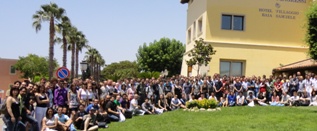
Before of ICVSS
The friday 8 of July Andrea Rueda and me traveled (in different flights) to Catania from Madrid. I arrived after of Andrea without know any of Italian but thanks of Google Maps and ask for the address showing a paper I finally find the accomodation place :)
The next day we went to Mount Etna which is imposing and impressive. At the end of this tour we can listen eruptions in the distance, the curious thing was that in the afternoon whereas waking in the center of Catania there was a volcanic ash rain clossing the airport all night. This was interesting but it was not a pleasant experience to feel the ash all over the body, because is like a very small and solid stone. Some of the students of ICVSS had to wait for the flight by the airport closed.
(volcanic ash cloud is comming)

(After of volcanic ash rain)

ICVSS starts
The sunday the bus was waitting for first group of ICVSS students that took us to the place of event. After of two hours of travel finally we are in Hotel Villagio Baia Samuele.
Poster sessions
The Summer School starts the monday with the lectures all day with poster session of two hours at the final. The difficult degree was thanks of the hot inside of both floors where the poster session was performed. It was exhausting, I don't stop to talk in the all session without any drop of water :(
But were more the good things :D, many people like our proposed approach, in fact one of the things that the people likes was the way which we adapt Bag of Features approach (originally of Computer Vision area) in our context to represent Histopathological images.
One first conclusion is that I must improve the overall method diagram, still it is not clear enought. The description of Nonnegative Matrix Factorization problem must be included in the poster and the automatic annotation method also, step-by-step. Some persons also like the combination of BOF with NMF and the analysis that allows NMF for latent factors as a part-based representation, however few people didn´t know NMF and the people that know it said that is interesting because NMF has been applied in other areas for text and object recognition but is not common in biomedical images.
(The poster and me)
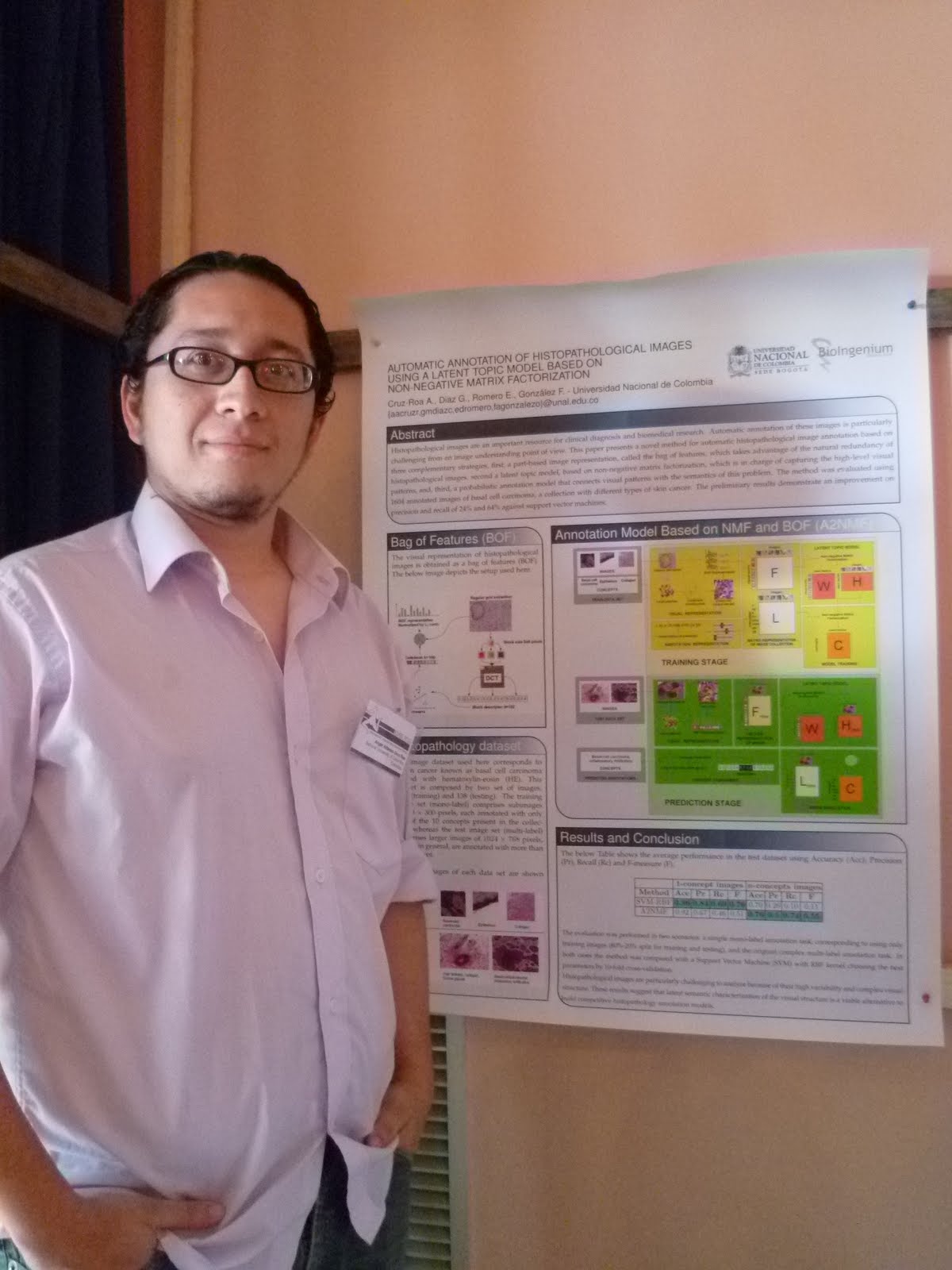
The common remarks about this work were:
It is a little weirdo the performance results obtained by SVM in accuracy and precision, in contrast with recall measure
- Maybe clarify that the classifiers are binaries and put how the performance measures were calculated over the average by image. Maybe use another measures like area under ROC curve, because the SVM model performance could be change according to threshold defined in the predicted labels.
- That is true, NMF doesn´t provide an unique solution. However the different solution are very closed. Maybe we must check this aspect, but in average NMF have similar results. This could be included in the way to present the results in future experiments. Nonnegative Tensor Factorization is a generalization of NMF that guarantees an unique solution, we must review and test this method.
- A: This database is not publicly yet, we are working in release but this take some time. We have another database that is publicly available of histology with images of tissues annotated by four concepts (http://www.informed.unal.edu.co/histologyDS/).
Are you going to test their method with other (similar and publicly) datasets?
- Yes, we must test with another datasets in histopathology images with several annotation by image. In fact also we can try with other kind of biomedical images, e.g. radiological images like ImageClef Medical database.
How the dataset was built? Who performs the annotations?
- A set of samples of basal cell carcinoma stained with Hematoxylin-eosin were digitalized from microscopy at the same magnification, which were globally annotated by an expert physician in pathology.
- Because NMF allows provide an interpretability layer of intermediate representation of images in latent space as a part-based representation in additive terms and not in terms of sums and substractions. The image, the concept or the latent factor is represented with mixtures in additive way of parts.
End of this part...
Monday, June 13, 2011
Designing poster for ICVSS 2011
Coming soon the ICVSS2011 will start and a poster about our preliminar results was accepted for its presentation.
A preliminar version was sent (see here in pdf) with the constraint that must be designed in LaTeX :S.
The second version (the last) is available here in pdf format or the image is depicted above (using the same template in latex):
(click in the image)

I just have two days for print the poster :O, so thanks in advance for your valuable and quickly feedback :$ . Apologies for that special request :)
Saturday, May 21, 2011
Otro día del fin del mundo que se acaba...

Hoy 21 de Mayo de 2011, al igual que en 1994, otro fin del mundo había sido pronosticado por Harold Camping, cristiano y presidente de la emisora Family Radio (http://nymag.com/daily/intel/2011/05/a_conversation_with_harold_cam.html).
Es curioso como ha pesar de las innumerables veces que este día ha sido pronosticado erróneamente, la mayoría por líderes o fanáticos religiosos, aun existen personas que siguen creyendo en ellos, aun cuando se equivocan ellos mismos mas de una vez como Harol Camping. En medio de su locura, la gente fanática y creyentes de este tipo de profecías llegan a realizar cualquier cantidad de estupideces para purgar sus pecados por temor del final de los tiempos, incluso atentar contra su propia vida.
Para no gastarle tanta tinta simplemente termino este Blog compartiendo la respuesta de la pregunta obvia que uno se debe hacer siempre en estos caso, ¿Cuantos días de fin del mundo han sido pronosticados (erróneamente por supuesto) en la historia de la humanidad?, buscando en Google encontré este enlace en donde se resumen distintas fechas del fin del mundo: http://www.taringa.net/posts/noticias/1409367/Profecias-incumplidas-del-Fin-del-Mundo.html
Los dejo con algunas noticias un día después del fin del mundo. Feliz fin del mundo No. 382!!, espero que hayan aprovechado el día porque seguro vendrán mas profecías para celebrar otro día como hoy. Nos vemos en el día del juicio final... Bazinga! :D
Sunday, January 2, 2011
Starting a new year: Between reasons and instincts
After of something more than a year without write in my blog, I think that a good way to start this year is follow my instinct. This instinct said me that I must share the introspection which I have in these last days of 2010 and two days starting this 2011.
I know that the most people did the same things in this season, review the goals reached, the failures, and planning the "new" list of objectives (normally are similar for all ¬¬). However one important conclusion that I have is that this list of goals are good, but is not enough. I mean, set goals is good for our lives in short and long time, but this question brings two problems that we don't take into account. The first is that we don't planning how to reach these goals (in general), and the end, when you evaluate them the number of goals are near the number of deceptions, which can be an unpleasant question. The second conclusion is we must not forget our instinct. Many times due to the routine, responsibilities, or other things, we repress some things that we want to do but finally we did not.
The two conclusions are related, because both can provide a disappointment or satisfaction. When we list the goals of year also we must planning how we reach them (step by step) in order to ensuring the goal. The time needed to reach each goal is different and we must take into account too. On the other hand, follow the instinct mean that, if we are doing the routine things and the tasks necessary to reach the planning goals and we have a feeling that we want to do something and we believe that we must do, just do it!. Try do it, is better than regretting not doing so.
Finally I just want that you keep in your mind these reflexions. Maybe you think that these are obvious but the point is put into practice. As far as I'm concerned, for years I've forgotten these thoughts and I just hope this year 2011 to start putting into practice the result of my introspection. To do this I hope to have a proper balance between my reason and instinct. Surely this will achieve different goals (both personal and professional) with the personal satisfaction of accomplishment.
Happy New Year!!! let omens aside, schedule and fight your goals, and don't forget to follow your instincts.
Tuesday, November 24, 2009
CIARP 2009 - Report
After having returned from CIARP2009 in Guadalajara, MX in which I present in poster modality the paper Visual Pattern Analysis in Histopathology Images Using Bag of Features and then to return to work and academic activities (including assisting the SIB-SIPAIM 2009) I describe what I'm experience both academically and personally in my first trip abroad.
Feedback
I must thank in first place to Francisco Gomez for preparation before of poster presentation in 30 seconds, it was really useful to present the idea in such a short time. Moreover, in the poster session I present on several occasions this work (I was lucky that everyone were from hispanoamerica, so it was in Spanish jeje: P). The main remarks were about the possibility of building the visual vocabulary automatically by a method of unsupervised clustering, as control or linking semantic information and the magnification of the images, and finally on the methodology designed for automatic annotation tasks.
Works of interes
- Texture analysis methods and applications. Prof. Maria Petrou University of Cambridge, UK. This was an interesting tutorial about texture analysis and description methods, also she shows your book about this. This is very important for the relationship with histology images for tissue description.
- We are Building a Topological Pyramid. Prof. Walter G. Kropatsch. Vienna University of Technology, Viena. This was other interesting tutorial about graph representation of objects in image processing for segmentation and others using topological and connectivity information in order to reduce this representation.
- Randomized Probabilistic Latent Semantic Analysis for Scene Recognition. Erik Rodner and Joachim Denzler. This was an interesting work that use bag of feature and pLSA for image categorization in natural scene images.
- Classifier Selection in a Family of Polyhedron Classifiers. Tetsuji Takahashi, Mineichi Kudo and Atsuyoshi Nakamura. An interesting paper where the authors proposed a classifiers for SVM where choose the decision space with polyhedrons that reduce the convex hull with relative better results.
- Clustering Ensemble Method for Heterogeneous Partitions. Sandro Vega-Pons and José Ruiz-Shulcloper. This work is about clustering method addressed to ensemble for heterogeneous partitions. The application in hierarchical clustering can be explored.
- Improved Online Support Vector Machines Spam Filtering Using String Kernels. Ola Amayri and Nizar Bouguila. Good paper about machine learning using string kernels and Transductive Support Vector Machines. The more interesting of this work is the exhaustive experimentation and configuration setup.
- A New Incremental Algorithm for Overlapped Clustering. Airel Pérez Suárez, José Fco. Martínez Trinidad, Jesús A. Carrasco Ochoa, and José E. Medina Pagola. This is a good work about incremental clustering, very useful when we have large datasets and when a new data arrive, we don't want the clustering again. Closely related with our work and maybe a collaborative work is possible.
Contacts
Ioannis A. Kakadiaris, Ph.D. He is Director of Computational Biomedicine Laboratory and Division of Bioimaging and Biocomputation Institute for Digital Informatics and Analysis at University of Houston, Houston, Texas, USA. He was the only keynote speaker who works in biomedical imaging. We spoke about cardiac image problems in 4D (spatial and time resolution trade-off) and the possibility of collaborative work and an invitation to Bioingenium Reseach Group for similiar research topics, to which he showed interest and possibilities under its schedule.
Lic. Airel Perez Suarez. He is a reseacher in computer science of Centro de Aplicaciones de Tecnologías Avanzadas (CENATAV). He works in data minning and information retrieval. He shows a paper about incremental algorithm for overlapped clustering and he is interested in test your algorithm with our histology images dataset and visual words for collaborative works.
Dr. José Ruiz Shulcloper. He is Director of Centro de Aplicaciones de Tecnologías Avanzadas (CENATAV) and president of the Cuban Association for Pattern Recognition. He invite us to start the fundation of Colombian Association for Pattern Recognition in order to enter at International Association of Pattern Recognition (IAPR). For this, he said that we can to start from an actual association related with pattern recognition (for example, Sociedad Colombiana de Computación), only we must send the information request for this purpose to your mail.
Erik Rodner. He is rearcher in chair of computer vision from Institute of Computer Science at University of Jena. He shows two works, one about image categorization using Bag of Features in natural scene images and object recognition using a visual feature combination with bag of features from 2D and 3D images.
Note: For future conferences is very important to carry presentation cards.
Photos

The Poster and me (academic evidence)

Pyramid of the sun, Teotihuacan. (evidence tourist)

El Lago, Chapultepec Forest. (like a picture-postcard)
Thursday, November 12, 2009
Final version of CIARP poster
Hi, finally I publish the final version of CIARP Poster. Excuse me the delay. I appreciate the comment, because tomorrow I going to print. The saturday is the travel!! :P. The flickr link to more specific annotation is here.


Sunday, October 25, 2009
Designing the poster for CIARP
Hi buddies, in a few days I hope to be in Guadalajara presenting a poster about the work that was accepted at 14th Iberoamerican Congress of Pattern Recognition. For this reason I must do it and I started to design it. So, I show the preliminar design to give me your opinion to improve it. Thank you very much.
The image is avaliable also in Flickr here.

Friday, October 23, 2009
How to evaluate the quality of clustering?
In last 3 days I am working in how to evaluate the clustering performance (or quality). The reason is that I need to determine the number of prototype blocks ("good" visual blocks of example) given a set of them for each category (e.g. nervous, muscle, etc.). For this, I have the similarity matrix of combined visual features (linear combination using weights founded by kernel aligment method) of image blocks.
I am using k-centers (also called k-medoids) method to find the k image blocks that can be a good representation of visual variability in each concept. The problem is: What k value is appropiate for select the representative blocks according the visual variability inside set of blocks images for a given concept?
One of the most popular methods to select the right value of k is by means of the silhouette coefficients.
The method to calculate the silhouette coefficient is:
For a given i point in a cluster A, the silhouette of i, s(i) is defined as follows:
s(i) = [ b(i) - a(i) ] / max { a(i) , b(i) }
where, a(i) is the average of dissimilarity between point i and all other points in A (the clusters to which i belongs) and b(i) is the average dissimilarity between point i and the points in the closest cluster to A, which is B in this case. Seek that -1<= s(i) <= 1. That means:
s(i) closest to 1, the object i is well classified
s(i) closest to 0, the object i is between two clusters
s(i) closest to -1, the object i is wrong classified
The average of all silhouettes in the data set S' is called the average silhouettes width for all points in the data set. The value S' will be denoted by S'(k), which is used for the selection of the right value of the number of clusters, k, by choosing that k for which S'(k) is as high as possible. The Silhoette Coefficient (SC) is then defined as follows:
s(i) closest to 1, the object i is well classified
s(i) closest to 0, the object i is between two clusters
s(i) closest to -1, the object i is wrong classified
The average of all silhouettes in the data set S' is called the average silhouettes width for all points in the data set. The value S' will be denoted by S'(k), which is used for the selection of the right value of the number of clusters, k, by choosing that k for which S'(k) is as high as possible. The Silhoette Coefficient (SC) is then defined as follows:
SC = max { S'(k) }
Partial solution
The first, I had to adapt the silhouette coefficient method for calculate it from similarity matrix. The method was developed in matlab and can be downloaded here.
I did several experiments varying the k value for a specific concept, but I found that when k value increases, the SC value also.
The reason that found is that when a cluster have only a object, the a(i) value of s(i) formula is NaN, because there are not others objects in the same cluster. This, when use the next formula
SumDist := sum(distances(i,j) | i ~= j, for all j belongs to Ai)
NObjs := count( j | for all j belongs to Ai)
where, i is the object and belongs to Ai cluster, and j is the others objects. Then I calculate a(i) thus:
The first, I had to adapt the silhouette coefficient method for calculate it from similarity matrix. The method was developed in matlab and can be downloaded here.
I did several experiments varying the k value for a specific concept, but I found that when k value increases, the SC value also.
The reason that found is that when a cluster have only a object, the a(i) value of s(i) formula is NaN, because there are not others objects in the same cluster. This, when use the next formula
SumDist := sum(distances(i,j) | i ~= j, for all j belongs to Ai)
NObjs := count( j | for all j belongs to Ai)
where, i is the object and belongs to Ai cluster, and j is the others objects. Then I calculate a(i) thus:
a(i) = SumDist/Nobjs
Then, the question is What must we do when Nobjs is cero? that means, How do take into account when a cluster have just one element?, How improve the silhouette measure using this?, Is it possible to include in some measure that penalizes when the number of objects per cluster is smaller than a given value?
Now my idea is vary the k-value until appears a cluster with just one element. In other words maximize the SC value and minimize the number-of-clusters-with-one-element.
I going try some experiments with this idea...
If you have some comments, if I'm doing something wrong or any idea to find a good value of k in an objective way, your comments will be welcome.
While, I will testing to finally show results of these experiments.
P.D.: Solve this problem can be useful also for summarize and 2D-visualization a large collection of images. I believe...
Kaufman, L. and P. Rousseeuw, 1990. Finding Groups in Data: An Introduction to ClusterAnalysis. John Wiley and Sons, London. ISBN: 10:0471878766.
Wednesday, October 14, 2009
Sparse representations
A "recent" paradigm to represent digital images has been used in signals previously and promises be the holy grail in computer vision by striking results. Then, the question is Why not study it?.
The first motivation is that a possible relation with my master's thesis exists.
In bag of features, we split the images in blocks, commonly called visual words, and then a feature description is done to represent these visual words. The process is performed in all images in a specific image collection. Then a visual codebook is built with more representative visual words in collection, an approach commonly used is by clustering, i.e. k-means. The visual codebook, or dictionary, is built and each image is represented by the occurrence of visual words according to codebook in image, the asignation is made by the most similar measure between visual word in image and a visual word of codebook.
In sparse representation, we choose a random blocks in an image, called dictionary D. Then, we want obtain a vector x that help to reconstruct the original image how a linear combination between them. The optimization problem is defined by sparse measure of zero norm and the best solution is given by the x vector most sparse. However, the D is not a square matrix and is indetermined problem with number of observations (cols) is greater than basis dimension (rows), so have many infinite solutions. The best solution is given by the x vector most sparse in norm zero, but it is a NP-hard problem. The sparse measure in norm one is a good aproximation and is the same solution in some cases of original optimization problem with advantage that is possible solve with a LP method (basis pursuit, matching pursuit, orthogonal matching pursuit, among others). With sparse solutions the dictionary is the best set of basis that represents the image content and more compact representation of image than fourier, wavelets, curvelets, etc.
I am working in this moment in this approach and how can help me in my master thesis... I hope :)
The first motivation is that a possible relation with my master's thesis exists.
In bag of features, we split the images in blocks, commonly called visual words, and then a feature description is done to represent these visual words. The process is performed in all images in a specific image collection. Then a visual codebook is built with more representative visual words in collection, an approach commonly used is by clustering, i.e. k-means. The visual codebook, or dictionary, is built and each image is represented by the occurrence of visual words according to codebook in image, the asignation is made by the most similar measure between visual word in image and a visual word of codebook.
In sparse representation, we choose a random blocks in an image, called dictionary D. Then, we want obtain a vector x that help to reconstruct the original image how a linear combination between them. The optimization problem is defined by sparse measure of zero norm and the best solution is given by the x vector most sparse. However, the D is not a square matrix and is indetermined problem with number of observations (cols) is greater than basis dimension (rows), so have many infinite solutions. The best solution is given by the x vector most sparse in norm zero, but it is a NP-hard problem. The sparse measure in norm one is a good aproximation and is the same solution in some cases of original optimization problem with advantage that is possible solve with a LP method (basis pursuit, matching pursuit, orthogonal matching pursuit, among others). With sparse solutions the dictionary is the best set of basis that represents the image content and more compact representation of image than fourier, wavelets, curvelets, etc.
I am working in this moment in this approach and how can help me in my master thesis... I hope :)
Subscribe to:
Posts (Atom)